
Advancing Precision Hyperbaric Oxygen Therapy: A Biomarker-Driven Framework Published in the Journal of Translational Medicine
PUBLISHED ON
October 23, 2026
Hyperbaric oxygen therapy (HBOT) has drawn growing global interest across multiple health disciplines, ranging from neural recovery and cardiometabolic support to tissue repair and healthy aging. However, translating laboratory discoveries into consistent clinical practice has faced a long-standing challenge: the lack of individualized quantification and standardized efficacy assessment.
Traditionally, HBOT protocols have largely followed disease-centric, empirical approaches. Without dynamic guidance from physiological and molecular biomarkers, an identical protocol can trigger disparate biological responses across different individuals due to variations in baseline inflammation, metabolic profiles, and microvascular function.
To address these translational bottlenecks, a collaborative research paper titled “Precision hyperbaric oxygen therapy: a biomarker-driven framework” has been accepted for publication in the international SCI peer-reviewed journal, Journal of Translational Medicine.
Co-developed by Yuanlfe Longevity Technology in collaboration with clinical hyperbaric specialists and academic research faculties, the paper focuses on a pivotal question: How can empirical hyperbaric oxygen interventions be transformed into a measurable, verifiable, and dynamically adjustable modality with predictive dose-response models?
Key Pillars: The 5-Point Practical Framework
Anchored in translational medicine and digital health principles, the authors outline an actionable, reproducible methodology designed for clinical investigators and researchers:
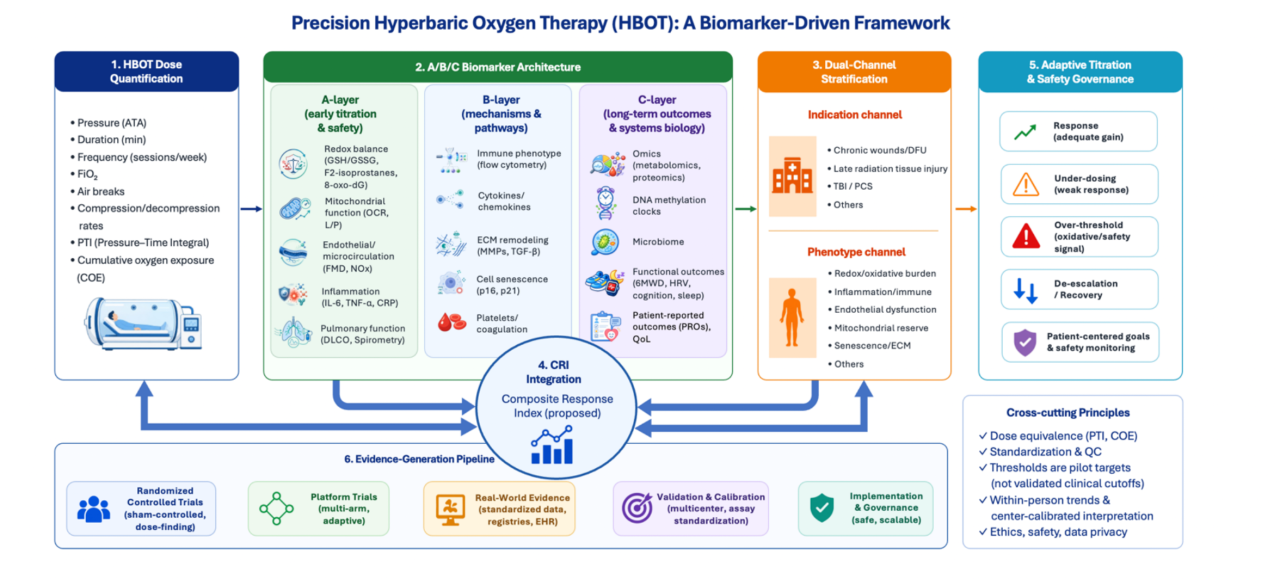
1. A Three-Tiered Biomarker Architecture
The paper defines a structured biomarker hierarchy to guide targeted interventions across temporal and physiological dimensions:
Tier A (Proximal Kinetics / Early Titration): Evaluates rapid cellular redox balance, mitochondrial respiration, and microcirculatory perfusion to establish real-time safety thresholds and dynamic protocol titration.
Tier B (Mechanistic Calibration / Pathway Validation): Assesses immunomodulation, markers of cellular senescence (e.g., SASP profiles), and extracellular matrix remodeling over intermediate horizons.
Tier C (Composite Endpoints / Longitudinal Value): Tracks epigenetic age alterations, multi-omics biological profiles, validated functional scales, and patient-reported outcomes.
2. Standardized Oxygen Exposure Quantification
Moving past arbitrary pressure-time metrics, the framework advocates for two standardized clinical parameters: Effective Pressure-Time Area and Cumulative Tissue Oxygen Exposure. Standardizing decompression curves, environmental cycling, and wash-in/wash-out kinetics ensures biological comparability across differing chamber technologies and study protocols.
3. Integrated Biological Response Indices
Rather than relying on isolated endpoints, the study outlines a composite scoring methodology that synthesizes Tier A, B, and C parameters. This multi-target index defines minimal clinically meaningful response thresholds and supports consistent dose-response modeling across multi-center initiatives.
4. Dual-Track Cohort Stratification
To optimize intervention protocols, the authors propose a dual-layer stratification model:
Clinical Indication Pathway: Aligns with defined diagnostic settings (such as tissue repair, radiation injury, or ischemic conditions).
Molecular Phenotype Pathway: Tailors oxygen exposure according to specific biological profiles, including high-inflammation/SASP states, microvascular endothelial dysfunction, and mitochondrial hypometabolic phenotypes.
5. Digital Twins & Closed-Loop Predictive Control
The research introduces an exploratory, lightweight digital twin model. By pairing continuous wearable telemetry (such as heart rate variability, sleep architecture, and movement activity) with Tier A biological indicators, the system helps model an individual’s dynamic physiological state vector. This supports AI-assisted micro-titration within strict safety boundaries, aligned with forward-looking SaMD (Software as a Medical Device) frameworks and human-in-the-loop clinical supervision.
Bridging Translational Research and Practical Application
By reframing HBOT into a quantified, controllable biological intervention, the study demonstrates the value of transparent, reproducible collaboration between research institutions and industry innovators.
Looking ahead, Yuanlfe Longevity Technology will continue partnering with academic institutions and clinical hyperbaric centers to advance biological age evaluation, validate age-related biomarker panels, and support evidence-based research initiatives.
Reference
S. Ersenberg, H. Lin, Y. Zhang, T. et al., Precision hyperbaric oxygen therapy: a biomarker-driven framework, Journal of Translational Medicine, 2026. DOI: 10.1186/s12967-026-08737-w