
Designing Rigorous Clinical Research in Hyperbaric Oxygen Therapy: A Practical Methodological Guide Published in Trials
PUBLISHED ON
July 23, 2026
 Hyperbaric oxygen therapy (HBOT) has garnered accelerating attention across global clinical and wellness communities for its role across physiological recovery, tissue support, and healthy longevity research. Yet, as the volume of preclinical and clinical studies expands, investigators face a fundamental roadblock: the lack of standardized trial methodologies.
Historically, significant discrepancies in subject selection, pressure titration, intervention duration, session frequency, and control group design have led to inconsistent evidence and poor reproducibility across independent trials.
To address these translational challenges, a collaborative research paper titled “Designing Clinical Research on Hyperbaric Oxygen Therapy: A Narrative Review and Practical Methodological Guide” has been published in the international peer-reviewed SCI journal Trials (Springer Nature).
Spearheaded by the R&D team at Yuanlife Longevity Technology alongside clinical hyperbaric specialists and academic research faculties, the paper tackles a central question in modern hyperbaric science: How can investigators design clinical trials that are scientifically sound, methodologically transparent, and replicable across multi-center settings?
Practical Recommendations for Designing Rigorous HBOT Trials
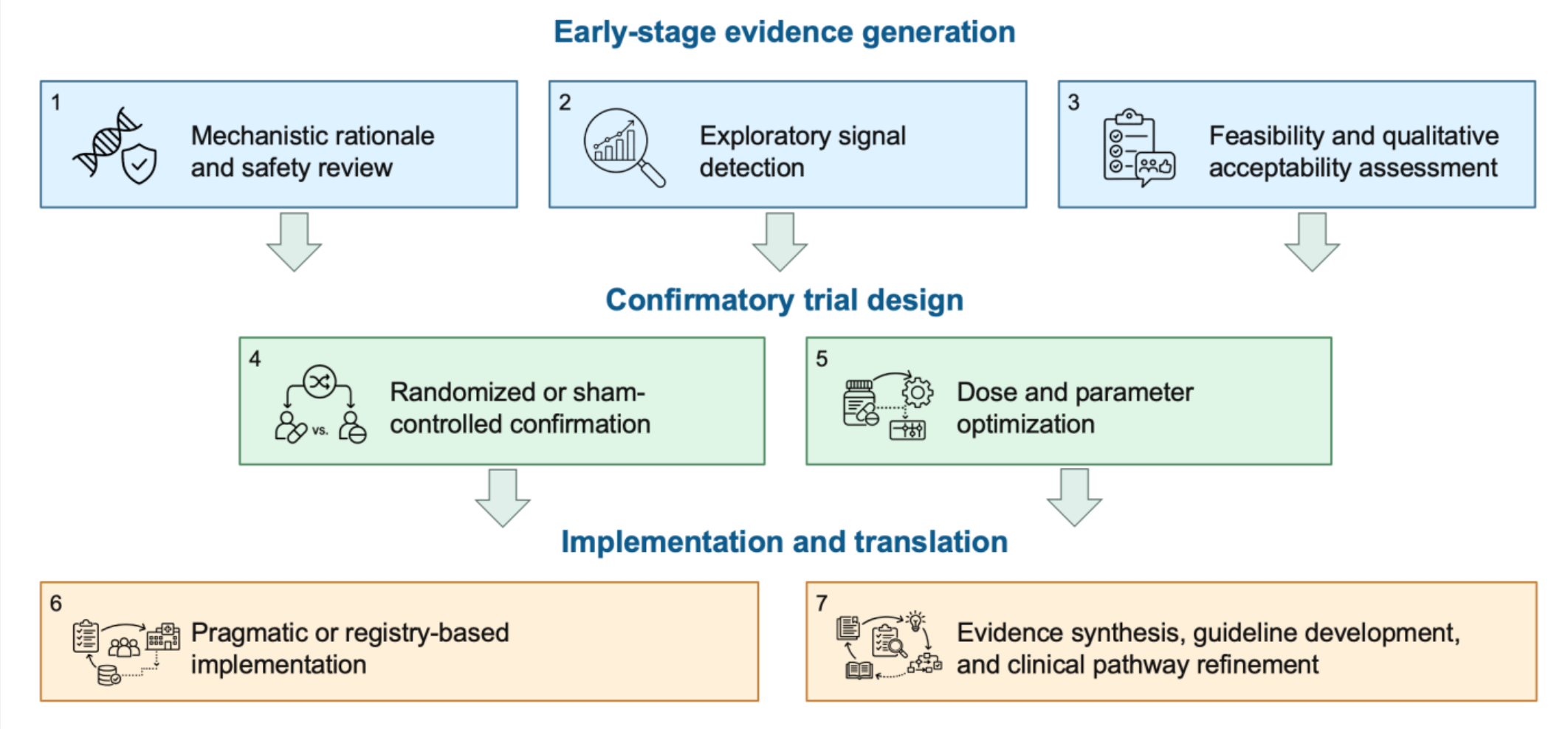
Synthesizing best practices from clinical trials and translational research, the paper outlines practical guidance across five key domains:
1. Selecting Appropriate Study Designs Based on Research Objectives
The authors categorize standard HBOT trial designs to match specific research phases:
Mechanistic & Exploratory Trials: Well-suited for hypothesis generation, initial observation, and preliminary mechanistic validation.
Physiological Response & Exposure-Titration Studies: Essential for identifying optimal operational windows, pressure profiles, and biological response curves.
Randomized Controlled Trials (RCTs): The benchmark for causal inference and confirmatory efficacy testing.
Real-World Studies (RWS) & Registry Cohorts: Crucial for pragmatic validation and longitudinal safety surveillance across diverse populations.
2. Standardized Reporting of Intervention Protocols
To resolve cross-study incomparability, the paper strongly recommends comprehensive, transparent reporting of core intervention parameters, including: absolute pressure with explicit unit specifications; oxygen delivery devices and breathing modalities; compression, constant-pressure, and decompression duration curves; per-session duration, weekly frequency, and total cumulative cycle length; as well as chamber environmental parameters and participant protocol compliance.
3. Establishing a Multi-Dimensional Outcome Assessment Matrix
Evaluating HBOT should move beyond isolated single markers. The authors advocate for an integrated matrix spanning multiple biological and clinical tiers:
Clinical functional scales & target-specific indicators
Laboratory indices & advanced imaging endpoints
Patient-Reported Outcomes (PROs) & quality-of-life assessments
Adverse event tracking & rigorous safety surveillance
Biomarkers & multi-omics profiling
Digital wearable telemetry & quantitative analytics
4. Navigating Inherent Methodological Challenges
HBOT trials encounter distinctive design hurdles compared to conventional pharmaceuticals:
Blinding Difficulties: Sensory cues (ear pressure, ambient temperature shifts) make true double-blinding technically challenging.
Sham Control Design: Developing inert sham protocols without inducing mild biological effects requires sophisticated pressure manipulation.
Baseline Variability: Disparate baseline vascular, metabolic, and inflammatory phenotypes require stratified cohort assignment.
Chamber Disparities: Cross-chamber technological variations demand pre-specified analytical adjustments, multi-center operating standardizations, and detailed protocol registration.
5. Enhancing Trial Transparency and Data Sharing
The authors highlight the necessity of prospective trial registration, public sharing of statistical analysis plans, and standardized adverse-event adjudication. Establishing harmonized standard operating procedures (SOPs) across multi-center initiatives significantly reduces operational bias and advances clinical data pooling.
Expanding the Research Horizon: Future Collaborative Directions
Looking forward, Yuanlife Longevity Technology will continue collaborating with leading clinical hyperbaric departments, universities, and research institutions across four strategic domains:
· Micro-Pressure & Hyperbaric Physiological Mechanisms: Investigating the dose-response relationship between varying pressures, oxygen concentrations, and metabolic profiles to establish personalized safety thresholds and individual biological evaluation.
· DNA Methylation & Epigenetic Aging Clocks: Deploying validated epigenetic aging clock models to quantify biological age alterations following hyperbaric interventions while avoiding single-test bias.
· Senescence Biomarker Panels: Tracking multi-marker pathways covering cellular senescence, systemic inflammatory response (SASP), mitochondrial function, and oxidative stress modulation.
· Gut Microbiota & Healthy Longevity Research: Evaluating the interplay between hyperbaric oxygen protocols, intestinal microecology, immune homeostasis, and systemic metabolic health.
Reference
H. Lin, et al., Designing Clinical Research on Hyperbaric Oxygen Therapy: A Narrative Review and Practical Methodological Guide, Trials, 2026. DOI: 10.1186/s13063-026-08895-x